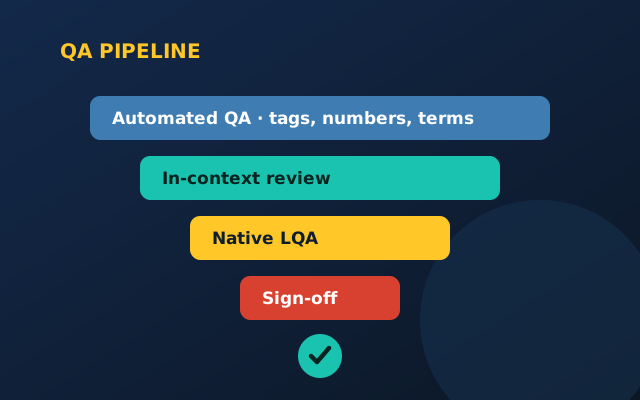
Localization quality isn't a final inspection you bolt on at the end — it's a pipeline of catches, each tuned to a different kind of error. Skip a layer and a specific class of bug walks straight through to your users. Here's how the layers stack, cheapest and most automated first.
Layer 1 — automated checks (free, instant)
Software is great at catching mechanical errors a human eye glazes over. A good automated QA pass (tools like Xbench, or the checks built into a TMS) catches:
- Missing or altered placeholders and tags (
{name},%s, HTML) - Numbers and dates that changed between source and target
- Terminology that ignores the glossary
- Untranslated segments, double spaces, inconsistent translations
- Length overruns against UI limits
Run this on every batch. It's cheap, repeatable, and removes the noise so humans can focus on judgment, not janitorial work.
Layer 2 — in-context review
Text that's correct in a spreadsheet can be wrong on screen: a label that fits the box in English overflows in German; a string that's a verb in context was translated as a noun. Reviewing translations where they actually appear — in a preview, a staging build, or the real layout — catches what no out-of-context check can.
Layer 3 — native linguistic QA (LQA)
A qualified native speaker reads for the things only a human notices: tone, naturalness, cultural fit, register, the honorific level that's technically correct but socially off. This is where "accurate" becomes "actually sounds like us". For Asian languages especially, this layer is non-negotiable.
Automated checks find what's broken. Humans find what's merely correct — and make it good.
Layer 4 — sign-off and feedback loop
Every error caught should teach the system. Feed confirmed issues back into the glossary, the style guide and the TM so the same mistake can't recur. A QA pipeline that doesn't learn just finds the same bug forever; one that does gets quieter every cycle.
How to phase it in
You don't need all four layers on day one. Start with automated checks (biggest catch for least effort), add in-context review for anything user-facing, and bring in native LQA for your highest-visibility content and markets. Then close the loop so each pass makes the next one cleaner.
The short version
Layer your QA: machines for the mechanical, humans for the meaningful, and a feedback loop so nothing recurs. Quality stops being a launch-day gamble and becomes a property of the pipeline.