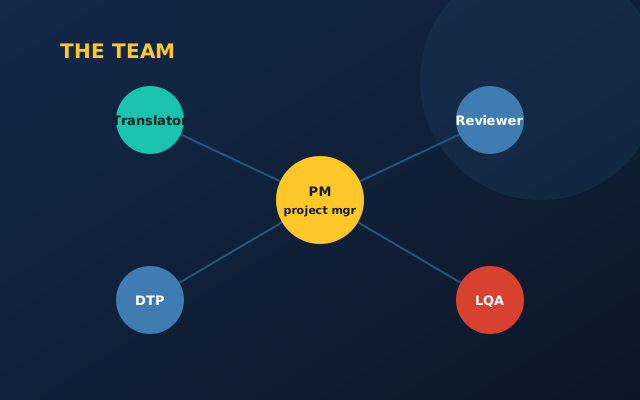
From the outside, "getting something translated" looks like one person typing in another language. Behind a properly localized product there's a small relay team, each handing off to the next. Knowing who does what helps you brief better, budget realistically, and understand what you're actually paying for.
Project manager — the conductor
The PM owns the whole thing: scope, quote, schedule, file prep, assigning the right linguists, chasing blockers, and being your single point of contact. A good PM is invisible when things go well and indispensable when they don't. This is the role that turns a pile of files and deadlines into a calm, predictable process.
Translator — the first draft
A native-speaker subject specialist who renders the source into their language. "Native and specialized" matters: a medical translator and a games translator are not interchangeable, and neither translates into a language that isn't their own. They work in a CAT tool with your TM and glossary at hand.
Reviewer / editor — the second pair of eyes
A second qualified linguist who checks the translation against the source for accuracy, consistency and style. This is the "two-linguist" standard, and it's the single biggest quality difference between cheap translation and professional translation. The translator writes; the reviewer catches.
DTP specialist — the layout
Once the words are right, someone has to make them fit — rebuilding the layout in-language so a brochure, manual or slide deck looks as good in Thai or Arabic as it did in English. This is where script shaping, line-breaking and font choices get handled (we go deep on that in our typography piece).
LQA & terminologist — the polish and the memory
LQA reads the final, laid-out result like a real user would, catching what only shows up in context. The terminologist (sometimes the same person, sometimes the PM) owns the glossary and TM — the institutional memory that keeps your fiftieth project consistent with your first.
One person can do a translation. It takes a small team to ship a localization you'd put your brand on.
How it flows on a small project
On a focused job, these roles compress: the PM might also manage terminology, one translator and one reviewer cover the linguistics, and a DTP specialist steps in only if there's formatting. The relay is the same — just fewer hands. What never collapses is the principle: nobody checks their own work. The second pair of eyes is the part you don't skip.
The short version
Behind every localized product is a relay — PM, translator, reviewer, DTP, LQA, terminologist — each owning one link. On small jobs the roles merge; on large ones they specialize. Either way, you're not paying for one person typing; you're paying for a chain of checks that adds up to something you can trust.