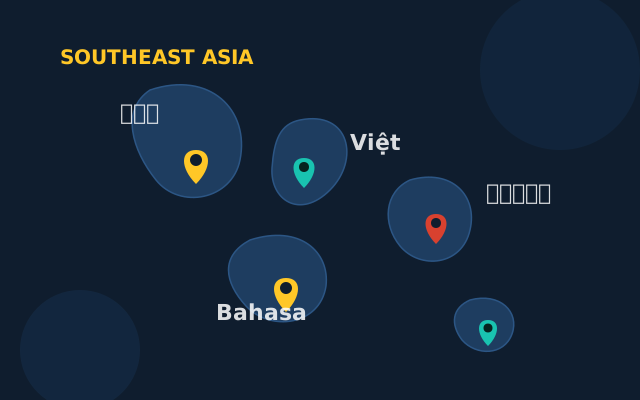
"We're launching in Southeast Asia" is the kind of sentence that hides a lot of work. SEA isn't a market — it's a region of very different countries with different scripts, different formality systems, and very different levels of English in everyday product use. Treating it as one locale is the fastest way to sound foreign in all of them at once.
Here's the practical, market-by-market view we give teams before they brief us — the things that actually change how you localize.
Vietnam (Vietnamese)
Latin script — which lulls teams into thinking it's easy — but loaded with diacritics that carry tone and meaning. Never strip the marks. "Ma", "má", "mà", "mả", "mã" and "mạ" are six different words. Your fonts must render stacked diacritics cleanly, and any text-processing (search, truncation, uppercasing) has to be Unicode-correct.
Formality lives in the pronoun system: there's no neutral "you". The right word depends on relative age and relationship, so tone choices are real decisions, not defaults. English is common among younger urban users, but a product that speaks natural Vietnamese earns trust quickly.
Thailand (Thai)
No spaces between words, so line-breaking needs a dictionary-aware engine (see our typography piece). Thai stacks vowel and tone marks above and below the consonant line, so line height and font choice matter more than in Latin layouts.
Politeness is encoded in particles (the polite endings differ by speaker), and there's genuine sensitivity around royal and religious language. Thai users generally expect to use products in Thai; English-only is a noticeably harder sell here than in the Philippines or Malaysia.
Indonesia & Malaysia (Bahasa)
Indonesian and Malay are close cousins — mutually intelligible in many cases — but not interchangeable. Vocabulary, spelling and register differ, and shipping Malaysian Malay to Indonesian users (or vice versa) reads as slightly off. Treat them as two locales.
Both use Latin script and tend toward a relatively informal, friendly register in consumer apps. English penetration in tech is high in both, especially Malaysia — but local-language UI still widens your reach beyond the urban tech crowd.
Philippines (Filipino / Tagalog)
The Philippines is the region's English outlier: English is an official language and widely used in business and tech. Many products ship English-first here successfully. But everyday speech is often Taglish — a natural code-switch between Tagalog and English — so a too-formal, fully-translated Tagalog string can ironically read as stiffer than the English it replaced. Match the register your users actually speak.
Cambodia (Khmer)
Khmer is a complex script with subscript consonants that stack below the baseline and no spaces between words — both shaping and line-breaking have to be right or the text renders as gibberish to a native reader. The linguist pool is smaller than for Vietnamese or Thai, so plan timelines with a little more buffer and lock your terminology early.
One regional string set, six different right answers. The teams that win in SEA localize per country, not "for Asia".
Things that cut across every market
- Names and forms: name order, honorifics and address formats vary — don't assume "First name / Last name".
- Payments: e-wallets and local methods dominate; surfacing the right ones per country matters as much as the words.
- Dates & numbers: format locally, and remember Thailand commonly uses the Buddhist calendar in some contexts.
- Tone: SEA consumer apps skew warm and friendly — a literal, corporate translation lands colder than the source.
The short version
Decide country by country how far to localize, keep Vietnamese diacritics and Thai/Khmer shaping intact, split Indonesian from Malay, and match the Philippines' real Taglish register instead of over-translating. Do that and "launching in Southeast Asia" becomes six confident launches instead of one blurry one.