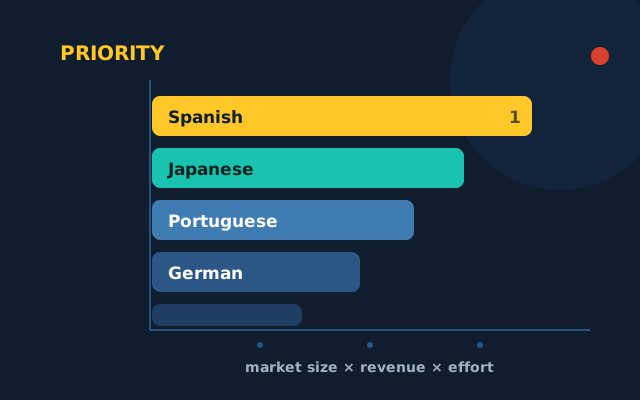
Most localization plans pick languages the wrong way: alphabetically, by the founders' own languages, or "the big ones — Spanish, French, German". Sometimes that's right by luck. Usually it leaves money on the table and spends budget where it won't move the needle. A better approach takes ten minutes and a look at your own data.
Start with the demand you already have
Before any market research, look inward. Your analytics already tell you where people are trying to use your product in another language:
- Traffic and sign-ups by country, and by browser/device language
- Where users drop off that correlates with language
- Support tickets and reviews not in your source language
- Where competitors are localized and you aren't
Demand that already exists — people pushing through an English product because they want it badly enough — is the cheapest signal you'll ever get. Serve it first.
Then weigh opportunity against effort
For each candidate language, score two things. Opportunity: market size, spending power, your existing demand, and how weak the local competition is. Effort: volume of content, script and DTP complexity, ongoing update frequency, and whether you can support customers in that language once you've invited them in.
You don't need a perfect model. Even a rough 1–5 score on each axis sorts your list into obvious "do first", "do next", and "later" buckets — and makes the decision defensible to whoever holds the budget.
Phase it — don't boil the ocean
Launching ten languages at once multiplies cost, QA and ongoing maintenance before you have any evidence it pays off. Start with a Phase 1 of two or three high-opportunity, manageable-effort languages. Measure what changes — conversion, retention, support volume, revenue per locale — then let the results fund Phase 2.
Localize where the demand already is, prove the lift, and let the winners pay for the next wave.
Mistakes we see most often
- Ignoring support and ops. Inviting users in a language you can't support in turns a win into a backlog of angry tickets.
- Picking by vanity, not data. The "obvious big languages" aren't always where your demand is.
- Forgetting maintenance. A language isn't done at launch — every product update is more words. Fast-changing products favor fewer, deeper locales.
- Underrating Asia. Markets like Japan, Indonesia and Vietnam are large and under-localized by Western-first competitors — often the best opportunity-to-competition ratio on the board.
The short version
Read your own analytics for existing demand, score each language on opportunity versus effort, ship a tight Phase 1, and expand on evidence. It beats "the big ones" every time — and it usually surfaces a high-value Asian market your competitors skipped.