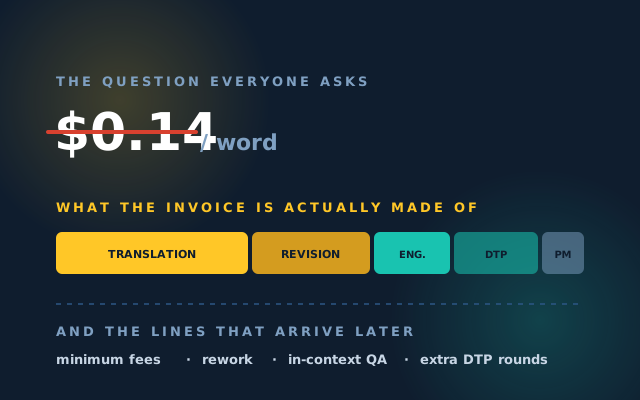
Almost every first email we get contains the same question: what's your per-word rate?
It's a fair question and a nearly useless one. Two vendors can quote the same $0.14 and deliver work that differs by a factor of three in effort — one is a single translator with a spellchecker, the other is a translator, a second linguist reviewing them, someone rebuilding your XLIFF, and someone reading the result inside the actual UI. The rate is identical. The thing you bought is not.
So here is the breakdown we'd want if we were the ones buying: what a quote is actually made of, what the numbers usually look like, which line items appear only after you've signed, and which levers genuinely move the total.
1. A quote is five line items pretending to be one
When you're given a single per-word number, someone has already averaged these together — or quietly dropped some of them:
- Translation. The first pass by a native linguist. Usually 55–70% of the language cost.
- Revision. A second, different linguist checking the first against the source. This is the line most often removed to win a bid. Ask explicitly whether it's included and who does it — "reviewed" sometimes means the same person read their own work again.
- File engineering. Getting your
.strings,.xliff,.json,.idmlor.pointo the tool with the right parser, placeholders protected, then rebuilding it so it still compiles. Billed hourly, usually $40–80. - DTP or QA. Rebuilding the layout for documents; reading strings in the running product for software. Not optional for either — just priced differently.
- Project management. Typically 8–15%, or absorbed into the rate. It buys you one person to email instead of nine.
A quote that shows all five is not more expensive. It's the same work, itemised.
2. The rate bands, honestly
These are the ranges we see quoted in this market in 2026 for business-grade work from English, with an independent reviewer included. Specialist domains — clinical, patent, regulated financial — sit 30–60% above the band. Marketing transcreation is priced per hour or per concept, not per word.
| Target language | Per source word | What drives it |
|---|---|---|
| Vietnamese, Indonesian | $0.08 – $0.12 | Deep talent pool, lower cost base |
| Thai, Filipino | $0.09 – $0.13 | Smaller pool; word-segmentation and QA overhead |
| Simplified Chinese | $0.10 – $0.15 | Huge pool, very wide quality spread |
| Traditional Chinese (TW / HK) | $0.12 – $0.17 | Two genuinely different locales, smaller pool |
| Korean | $0.14 – $0.20 | High domestic cost base; register work |
| Japanese | $0.15 – $0.22 | Highest in the region; register plus typographic overhead |
| Khmer, Lao, Burmese | $0.14 – $0.22 | Scarcity, not difficulty |
| French, German, Spanish, Italian | $0.10 – $0.16 | Mature and competitive |
A number well below the band isn't a bargain, it's information. At $0.05 into Japanese there is no reviewer, and quite possibly no human first pass either. That's a legitimate thing to buy for internal content — just buy it knowingly.
If you haven't decided which of these you actually need yet, start with which languages to localize first — sequencing saves more money than negotiating does.
3. Where the discount comes from — and where it stops being real
Your translation memory is the one asset that makes localization cheaper over time. Every segment you've paid for once gets reused, and you pay a fraction for the reuse. Vendors apply a match grid to the analysis:
| Match type | You typically pay |
|---|---|
| Repetitions (within the same job) | 25% |
| 100% match from TM | 25% |
| 95–99% | 40% |
| 85–94% | 60% |
| 75–84% | 80% |
| No match | 100% |
Three things worth knowing about that table:
- A 100% match is not free work. The words are identical; the context may not be. "Save" as a button and "Save" as a section heading are the same segment and different translations in Japanese. The 25% pays for someone to notice. Vendors who charge 0% on 100% matches are promising not to look.
- Below 75%, the grid is a trap. Editing a 60% match is usually slower than translating fresh, because you have to read, diagnose and unpick someone else's sentence. Good vendors don't offer discounts down there. Be suspicious of ones that do.
- A grid on a TM you don't own is a discount you can't take with you. Get the ownership clause in writing, and ask for a TMX export at the end of every project. This is the single most valuable sentence in a localization contract.
If the mechanics of matches and segments are new, CAT tools explained covers them properly.
4. What the MT discount actually buys
Machine translation post-editing typically comes in 30–40% below the human rate. That discount is real, and so are its limits.
What you're buying is a linguist correcting a draft rather than writing one. On repetitive, factual, high-volume content — support articles, product feeds, internal documentation — the draft is decent and the editor is genuinely faster. On UI strings, marketing, or anything where tone carries meaning, the editor spends the saved time rewriting, and you've paid for a discount you didn't get. Worse, editors anchor to the machine's phrasing; the output is correct and lifeless.
Rule of thumb: MTPE below about 8,000 words rarely pays for the engineering around it. When MTPE works and when it doesn't goes through the content types one by one.
5. The line items that arrive after the quote
None of these are dishonest. They're just usually not on page one.
- Minimum fees. $30–60 per language, per job. Five 40-word hotfix batches into six languages cost roughly ten times what the same words cost batched once. This is the most common way small teams overspend, and it is entirely avoidable.
- Rework from missing context. A string sent as bare text gets translated as bare text. Send it with a screenshot, the key name and the character limit and it gets translated as a button. Context is free to supply and expensive to omit.
- Late source changes. Edits after handoff are re-analysed as new work, and they break the fuzzy matches around them. Freezing the source for the duration is worth more than any rate negotiation.
- In-context review. $35–60 per hour, and the cheapest quality you can buy. Budget four hours per language on a first release.
- Glossary and style guide setup. A one-off $300–800. It pays back on the second project and every one after it — see the glossary translators actually use.
- DTP rounds beyond the included two. Ask what the limit is before the third round, not during it.
6. The work that isn't priced per word at all
| Work | Unit | Typical |
|---|---|---|
| DTP — simple layouts | per page | $8 – $15 |
| DTP — CJK, RTL, heavy graphics | per page | $15 – $30 |
| Subtitle translation | per source minute | $6 – $12 |
| Full subtitling (timing, QC, burn-in) | per source minute | $12 – $25 |
| Human voice-over | per finished minute | $150 – $400 |
| Transcription | per audio minute | $1 – $3 |
| File engineering / LQA | per hour | $40 – $80 |
CJK and RTL DTP costs more for a concrete reason, not a surcharge: line-breaking rules, vertical alignment and text expansion mean the layout genuinely has to be rebuilt rather than reflowed. Typography for CJK and Southeast Asian scripts shows what that actually involves.
7. Two quotes, added up properly
A mobile app: 12,000 words into Japanese, Korean and Vietnamese
The analysis comes back as 8,400 new words, 1,800 fuzzy matches and 1,800 repetitions. Applying the grid gives 9,930 weighted words per language.
- Japanese @ $0.18 — $1,787
- Korean @ $0.17 — $1,688
- Vietnamese @ $0.10 — $993
- File engineering, 3 hrs @ $55 — $165
- In-context LQA, 4 hrs × 3 languages @ $45 — $540
- Project management, 10% — $517
Total ≈ $5,690, or about $0.16 per source word per language.
Now compare the tidy version: "$0.14 flat, three languages" on 12,000 words is $5,040. It looks cheaper by $650. It contains no engineering, no LQA and no stated reviewer — so you'll do the first in-house, skip the second, and find out about the third when the Japanese ships in the wrong register. The headline rate was lower. The delivered number wasn't.
A 40-page product manual into Simplified Chinese, from InDesign
9,500 words, weighting to 7,400 after matches.
- Translation + revision @ $0.12 — $888
- DTP, 40 pages @ $12 — $480
- Linguistic sign-off on the output PDF, 2 hrs @ $45 — $90
- Project management, 10% — $146
Total ≈ $1,604 — and the translation is barely half of it. For document work, negotiating the per-word rate is negotiating the smaller number. What moves this quote is sending clean, well-structured InDesign files with live text instead of outlined type.
8. The levers that actually move your total
Ranked by how much they save, not by how satisfying they feel:
- Batch your updates. Weekly or per-sprint, never per-ticket. Minimum fees punish drip-feeding harder than any rate difference rewards you.
- Send context with the strings. Screenshots, key names, character limits, a note on who's speaking. Costs you nothing and removes most of the rework.
- Own your TM and termbase. Reuse compounds. By the third project it's a discount nobody has to grant you.
- Fix the source first. Concatenated strings, hardcoded text and missing plural forms all get billed to you eventually — see the pre-localization checklist.
- Tier your content. Your pricing page, your error strings and your changelog do not need the same treatment. Deciding that explicitly is usually a 20–30% saving on the whole programme.
- Phase the languages. Two done well beats six done thinly, and the second wave costs less because the glossary already exists.
Notice that five of the six are things you control, not things you negotiate.
9. Six things worth asking before you sign
- Is revision by a second linguist included, and what are their credentials?
- What's the match grid, and does it stop at 75%?
- Who owns the translation memory, and can I export a TMX at any time?
- What's the minimum fee per language, per job?
- How many DTP or QA rounds are included?
- Who is the actual linguist — in-house, a regular freelancer, or whoever's free?
A vendor who answers all six plainly is telling you something useful, whatever the rate turns out to be.
The short version
The per-word rate is the smallest interesting part of a localization quote. What decides your real cost is whether a second linguist is in the loop, whether you own the memory that makes next year cheaper, whether your files arrive in a state anyone can work with, and whether you send fifty small jobs or one batched one.
Get those four right and the rate becomes a rounding error. Get them wrong and no discount will save you.